Showing posts with label ANA. Show all posts

Saturday, August 14, 2010

Operation Omid Sey – clearing the road to Gereshk

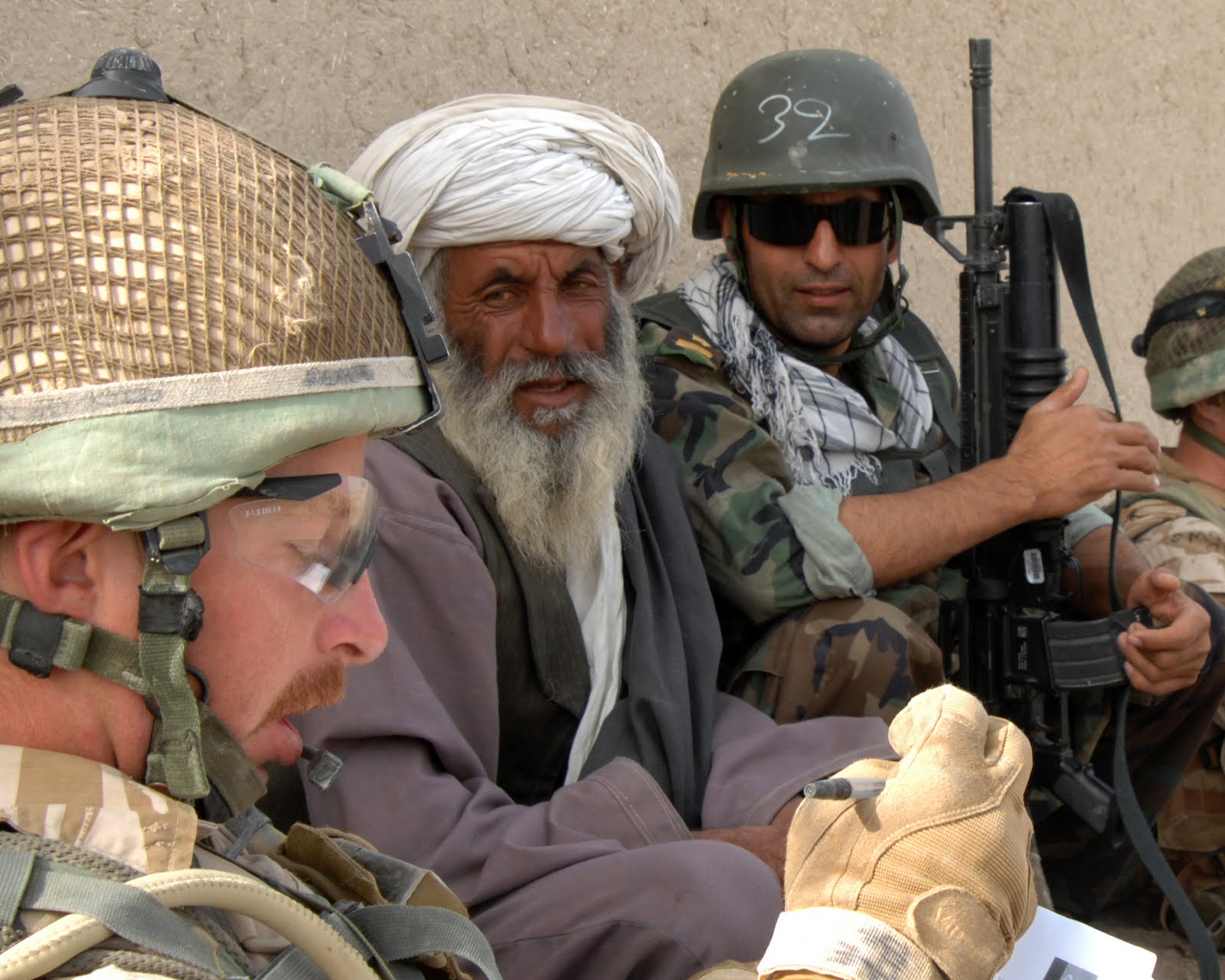
Following the success of Operation Tor Shezada in southern Nad-e Ali, where ISAF forces cleared numerous IEDs from key routes and installed new checkpoints, the Afghan National Security Forces have led an almost identical operation in central Helmand Province.

The Afghan National Army and Afghan National Police, working together on a major operation for the first time ever, at one point found IEDs at the rate of one an hour in Helmand’s second largest town, Gereskh.

ANA and ANP plan together for Op Omid Sey

The aim of the operation was also to drive insurgents out of the densely populated area with the support of ISAF troops and to build two new permanent police checkpoints to enhance security for local people.

Afghan counter-IED teams were brought from as far afield as Sangin and Nad-e Ali to search for roadside bombs which have been threatening the lives of civilians, soldiers and police alike in Helmand’s second largest town, Gereskh. One day they found eight in eight hours. The next day they found seventeen between dawn and dusk.

Most had been laid on a road alongside the canal, leading to an existing police checkpoint which had been attacked repeatedly in recent months. The road was also the direct route to market for the locals.

They hadn’t used it for months but were keen to see it reopened.

One Gereskh resident, Ali Mohammed, said: “The road is completely blocked by IEDs and we have to carry goods to market through the fields. I now have a really bad back as a result. We can’t wait to be able to use it again.”

ANP officer searches for roadside bombs as his commander watches on, with the support of ISAF troops

ISAF troops have attempted to use it but at their peril.

Warrant Officer John Waring, of 1 Mercian Regiment, said: “My vehicle had an IED strike here. A sizeable device, buried underneath the road. This device was believed to be a remote controlled device specifically designed to disable or destroy vehicles.”

The ANA Brigade Commander for 3/215 Brigade, Colonel Sheerin Shah, said: “Our mission is to open this route, clear all the IEDs and help keep it secure so that local people can use it.” But this was the first time the ANA and ANP had collaborated on an operation of this size. Both the ANP and ANA provided counter-IED search teams, trained by ISAF forces, and committed men and resources to protecting the counter-IED mission and the building of the two new checkpoints along the canal.

The ANA built them for the ANP, with British Army Engineers offering advice and support.

ANA Lieutenant Colonel Jangbaz said: “The ANA has equipment and this is the reason that we are building checkpoints for the ANP with the support of ISAF forces, for the local nationals.

Lieutenant Colonel Charlie Herbert, the Commanding Officer of the First Battalion, the Royal Regiment of Scotland (1 Scots), who also heads the Task Force Helmand Brigade Advisory Group, said the operation had been a huge success.

“The ANA and ANP proved they can do anything that ISAF can do,” he said. “The numbers say it all. They had 600 troops on the ground and we had just 100 offering support and advice. They seized the task with both hands and fulfilled it well. It is a great model for the future.”

Photos: Sarah Yuen/MOD 2010

Add to FaceBook

Tuesday, August 10, 2010

Afghan forces raise the country’s flag above Sayedebad, Helmand as the Decisive Phase of Op TOR SHEZADA comes to a close

Members of the Afghan National Army (ANA) have raised the country’s flag above the town of Sayedebad, which is now under ISAF and ANA control.

Sergeant Sheraga from the Afghan National Army said, “We are proud, as we have now taken control of this area. Before this area was under the control of the Taliban. They disturbed all the people. Now we are very happy. We appreciate the International Security Assistance Force in helping us with this mission.”

Sergeant Sheraga of the Afghan National Army standing in front of a recently raised Afghan flag in Sayedebad.

At the same time, forces from Corunna Company, the 1st Battalion The Duke of Lancaster’s Regiment completed their clearance of the road from Nad-e-Ali to Sayedebad and met up with their sister company, Somme, who had held the town since Monday 2 August.

Lieutenant Colonel Frazer Lawrence OBE, Commanding Officer of 1LANCS on his arrival in the town to see troops and the progress made said, “The operation has been a huge success. There really hasn’t been much fighting at all. There has been a tiny bit of harassing fire from the insurgents, but effectively we have stolen the town of Sayedebad.”

Soldiers from Somme Company were treated to a cooked meal of fresh rations, before Lieutenant Colonel Lawrence patrolled through the town with his troops. On the way he spoke to locals, asking them about the arrival of ISAF and the ANA.

He commented, “It is a huge step forward for [the population]. The trick is now to secure the town with our Afghan partners and that will set the conditions for reconstruction and development to take place but importantly, for the District Governor to get down here, meet his people, confirm their needs, and then start to improve their quality of life.”

The Officer Commanding Somme Company, Major Darren Newman briefing the Commanding officer of the 1st Battalion the Duke of Lancaster’s Regiment, Lt Col Frazer Lawrence OBE on the current situation on Sayedebad.

Working with the District Council and the District Governor over the coming weeks, ISAF will look to conduct development projects in the region. “The aim is to improve the school, get the school working again. To clean out irrigation ditches and to meet the other needs that [the population] are bound to have.” said Lieutenant Colonel Lawrence.

Somme Company extracted by Chinook helicopter as daylight broke on the 6th day of the operation after handing the security of the town over to Corunna Company and the Afghan National Army.

A community shura took place on 09 August 2010 involving more than 60 key leaders, tribal elders and members of the Security Council and Government of Islamic Republic of Afghanistan. Lt Col Frazer Lawrence, District Governor Habibullah and a senior representative from the Ministry of Education were in attendance to discuss the progress and how the area will move forward now that the security has improved. Numerous stabilisation and reconstruction projects were discussed and will begin in earnest in the next few days whilst the Check Points are being fortified. There will remain a continuous ANSF presence in the region to continue to provide the security to allow freedom of movement and to permit economic development.

Photos: Cpl Barry Lloyd RLC/MOD 2010

Add to FaceBookAdd to Twitter

Afghan security forces conduct joint operation to clear areas of threat around Lashkar Gah, Helmand

Afghan security forces from the Afghan National Army (ANA), Afghan National Police (ANP), Afghan Border Police (ANBP), Afghan Civil Order Police (ANCOP) and ISAF soldiers from the 1st Battalion The Scots Guards acting as part of the Brigade Advisory Group, the 2nd Battalion The Royal Welsh and the Counter IED Taskforce have completed a clearance operation around Lashkar Gah in southern Helmand. The operation was jointly planned by Afghan security forces with guidance from ISAF advisors.

Afghan National Army and ISAF Commanders discussing plans before the operation.

Lieutenant Peter Foster, 1st Battalion The Scots Guards and commander of the Brigade Advisory Group attached to the detached Kolay of the 4th Kandak, Afghan National Army said, “This morning’s operation was basically planned and conducted by Afghan security forces. There was a small ISAF contingent there to help with the planning and execution of the operation…..The operation was good. It pretty much fulfilled what it was meant to do. It got Afghan security forces working together, which is extremely good.”

The operation was part of an initiative by the Provincial Governor, Governor Mangal, to clear key areas close to the provincial capital of Lashkar Gar which he considered to be a threat. It involved 300 Afghan security forces and 40 ISAF troops who amassed on the start line to the west of the city in the early hours before stepping off at first light. ISAF forces attached to the troops provided mentoring and guidance to the advancing Afghan forces and their commanders. The aim was to enhance the effectiveness of the overall operation and develop the skills of Afghan forces.

Soldiers from the Afghan National Army lined up with their impressive arsenal of weaponry before the operation starts.

“We plan operations jointly. We give them as much as advice as possible as to how to make it an effective operation and how we can interact our assets with their numbers and their face. Essentially we’re looking to give an Afghan face as much as possible, because the Afghan people want to see Afghan soldiers,” said Lieutenant Foster.

He continues, “Out on the ground my job is to specifically mentor the commander. I’ll give him advice and direct him where he needs directing to further develop his soldiering skills. In terms of controlling his troops, that is his job. I am merely there to advise him.”

Supported by Counter IED teams, Warrior armoured fighting vehicles and aviation support if the troops faced significant resistance, the ANP and ANA patrolled south down two separate geographic corridors. Both the ANA and ANP contingents were able to reach their objectives without incident, although the Counter IED Taskforce was deployed to deal with potential IEDs. After the operation, the Afghan security forces took part in a debrief session with ISAF troops to review how the operation how gone.

Operations of this nature which are jointly planned and use partnered troops are the next step as ISAF moves towards Afghan-led security in and around Lashkar Gah.

Photos: Cpl Barry Lloyd RLC/MOD 2010

Add to FaceBookAdd to Twitter

Afghan security forces conduct joint operation to clear areas of threat around Lashkar Gah, Helmand

Afghan security forces from the Afghan National Army (ANA), Afghan National Police (ANP), Afghan Border Police (ANBP), Afghan Civil Order Police (ANCOP) and ISAF soldiers from the 1st Battalion The Scots Guards acting as part of the Brigade Advisory Group, the 2nd Battalion The Royal Welsh and the Counter IED Taskforce have completed a clearance operation around Lashkar Gah in southern Helmand. The operation was jointly planned by Afghan security forces with guidance from ISAF advisors.

Afghan National Army and ISAF Commanders discussing plans before the operation.

Lieutenant Peter Foster, 1st Battalion The Scots Guards and commander of the Brigade Advisory Group attached to the detached Kolay of the 4th Kandak, Afghan National Army said, “This morning’s operation was basically planned and conducted by Afghan security forces. There was a small ISAF contingent there to help with the planning and execution of the operation…..The operation was good. It pretty much fulfilled what it was meant to do. It got Afghan security forces working together, which is extremely good.”

The operation was part of an initiative by the Provincial Governor, Governor Mangal, to clear key areas close to the provincial capital of Lashkah Gar which he considered to be a threat. It involved 300 Afghan security forces and 40 ISAF troops who amassed on the start line to the west of the city in the early hours before stepping off at first light. ISAF forces attached to the troops provided mentoring and guidance to the advancing Afghan forces and their commanders. The aim was to enhance the effectiveness of the overall operation and develop the skills of Afghan forces.

Soldiers from the Afghan National Army lined up with their impressive arsenal of weaponry before the operation starts.

“We plan operations jointly. We give them as much as advice as possible as to how to make it an effective operation and how we can interact our assets with their numbers and their face. Essentially we’re looking to give an Afghan face as much as possible, because the Afghan people want to see Afghan soldiers,” said Lieutenant Foster.

He continues, “Out on the ground my job is to specifically mentor the commander. I’ll give him advice and direct him where he needs directing to further develop his soldiering skills. In terms of controlling his troops, that is his job. I am merely there to advise him.”

Supported by Counter IED teams, Warrior armoured fighting vehicles and aviation support if the troops faced significant resistance, the ANP and ANA patrolled south down two separate geographic corridors. Both the ANA and ANP contingents were able to reach their objectives without incident, although the Counter IED Taskforce was deployed to deal with potential IEDs. After the operation, the Afghan security forces took part in a debrief session with ISAF troops to review how the operation how gone.

Operations of this nature which are jointly planned and use partnered troops are the next step as ISAF moves towards Afghan-led security in and around Lashkar Gah.

Photos: Cpl Barry Lloyd RLC/MOD 2010

Add to FaceBookAdd to Twitter

Saturday, August 7, 2010

Force for change: the women of the new Afghan army

By Lalage Snow, Daily Telegraph

For the first time since the dark days of the Taliban, 29 women have been recruited to serve in the Afghan army.

It was Haniffa Rezai's mother, a policewoman, who encouraged her to join the Afghan National Army (ANA) instead of going to university, but the seed had been planted many years earlier. 'When the Taliban were in power we lived in Iran and our neighbour was in the Iranian army,' Rezai says. 'His guards would salute him when he came home and I used to copy them. It made me want to learn how to march. One day, I will be the one who is saluted, just like him.'


In a country notorious for the suppression of women, Rezai, 20, is a pioneer. She is one of the first 29 women who are undergoing specialist officer training in the ANA. After a swearing-in ceremony in May the girls began 20 weeks of training in the military basics – uniforms, drill, formation, weapons (although they will not be carrying firearms on a daily basis), first aid and physical training – as well as a specialist trade, either finance or logistics. They are taught by a team of female Afghan instructors under close observation from 10 female American soldiers from 95th Division Institutional Training.

Once qualified, they will work in combat support units alongside male soldiers. Although many of the women hope, eventually, to be deployed on the front line, their initial roles will be office-based. They will be assigned key duties in the running of military bases, particulary relation to equipment procurement and supply.

With billions of dollars being provided by the Obama administration, Afghanistan's army is set to double in numbers from 134,000 to 270,000 over the next two years, enabling the Nato-led International Security Assistance Force (ISAF) to withdraw by 2014. Although women have served in the Afghan army in the past this is the first time that officer training has been available to them – part of a plan to make the number of female soldiers 10 per cent of the total.

'After years of Taliban rule, it is great that we can recruit women again. We need more women to join,' Col Abdul Rahim, the commander of the ANA's Officer Training Brigade in Kabul, explains. 'We need women to relieve men of certain administrative jobs, and we eventually hope that they will be able to become nurses and drivers. Also, it is important to show the advancement of Afghanistan to the rest of the world.'

In February, as part of a recruitment campaign, a television advertisement invited women aged between 19 and 35 with at least nine years of education (common in the larger cities) to join up. Only about 100 applied and, of these, 45 met the criteria (35 began training and six dropped out in the early stages). Suria Salay, 19, was one of them. 'When I saw the ad on television I was so excited,' she says. 'I was thinking about going to university to become a lawyer or a journalist, but this is a much better opportunity for me – I get to learn things here that I wouldn't learn anywhere else. The situation for young women in Afghan­istan is still bad – some families are open-minded but many just keep their daughters at home until they are old enough to marry.'

Laila Ibrahimi saw the ad, too, but it was her husband, himself an officer in the ANA, who encouraged her to apply. 'I always wanted to be strong and serve the country,' she says. Now 31, she was married at 18 and has had three children, but she is pragmatic about their arrangements: 'My husband's first wife looks after them.'

Habiba Sayed, 28, who is married with four children, says, 'I was thinking about joining the police force but then I saw the ad. It is a totally new idea. I had to come and see what it was like.' Sayed has a strong personal reason for joining up. 'Three years ago, my 15-year-old cousin was playing with some friends in the street. I don't know why, but the Taliban killed them all. Their bodies were so mutilated that he could be identified only by a scar on his hand. Putting an end to such brutality is why I wanted to join the army. It is something in my heart.'

The women are based in the Female Officer Cadet School at the ANA's Command and Staff College, a military base on the outskirts of Kabul. Their section of the base – two buildings containing classrooms and an accommodation block – is accessed by securely locked metal doors with the words no male visitors allowed written on them in English and Dari. The recruits spend every minute behind these doors, apart from meal times in the base's main 'chow house' – though they are kept in their own area, away from the men. They are allowed home at weekends (most live too far away to make the journey).

The cadets' training began with an eight-week general introduction, an opportunity to learn the military mindset, which was a shock to the system for many of them. 'At first it was hard,' Capt Jannis Lullen, one of the American mentors, says. 'It was inevitable, with this being the first group, that they'd have no concept of army discipline. At the start, some of them would fall asleep in class or talk to each other, or refuse to do their homework. But we are halfway through now and they have responded well. They are eager to learn and want to improve themselves.'

Discipline is something all the cadets now seem to enjoy, Habiba Sayed says. 'We like being taught how to be on time, to respect each other and work together as a team. It is an American thing and a bit alien to Afghan culture, where rules are always bent. But it is helping us to become stronger physically and mentally and to understand the importance of following orders. It gives us self-esteem.'

The women are now in the second (12-week) phase of their training. Waking at 4.30am to pray, they clean their barracks before going to breakfast. At 8am their first class of the day begins: computers and English. Although some of the girls already speak English – learnt at school and from films and music – military vocabulary is another world. Key words are written on the whiteboard: echelon, locker, barracks, convoy.

At 10am they are divided into their respective trades, finance and logistics. Classes continue after lunch and prayers until 4pm, when there is the most popular class of the day, PT.

'Most of the girls hadn't done any physical exercise in their lives,' 1st Sgt Kristian Norton, another American mentor, recalls. 'They had never felt their blood pumping and so thought they were having a heart attack. They'd cry out, "I'm dying!" and burst into tears. Now they just love doing sport.'

'Sport helps us to be physically strong, like men,' Mori Sherifzada, 19, says. 'I love doing press-ups,' Zahra Bayat, also 19, adds. 'When I go home at weekends my friends ask me to teach them all the new exercises I've learnt.' Bayat joined up at the suggestion of her brother. 'He is in the army and whenever he came home I would put his uniform on and march around the house.'

After PT they clean the barracks, do homework, have an evening meal and then have free time until lights out at 9pm. Around camp the cadets wear their uniforms: green combats, boots and a black scarf to cover their hair. The women say they like army dress. 'We are doing a man's job and so it is only right that we wear the same as them,' Bayat says. 'My mother cut my hair short like a boy's when I joined and it looks so much better with the uniform. At home I now wear my PT kit [an army-issue tracksuit], which my family find strange as I used to wear more feminine clothes and softer colours. But it's what I like wearing now.'

There is a palpable sense of excitement and pride among the recruits, even though their country remains a dangerous place, not least for military personnel. Meanwhile, the road to female emancipation continues to be a rocky one. The situation for women in Afghanistan has improved markedly since the Taliban were toppled from power in 2001, and the recently adopted Afghan constitution states that the 'citizens of Afghanistan – whether a man or woman – have equal rights and duties before the law'. Women have been allowed back to work, are no longer required by law to wear the full burka and have been appointed into prominent government positions. But change is a slow process. In many rural areas the suppression of females continues, with many unable to participate in public life, forced into marriages and denied education. Fear of the Taliban remains.

Maryam Youssefy, 19, says, 'The last time I went home to Ghazni [in eastern Afghanistan] I was so scared that the Taliban would somehow find out that I am in the military and kill me that I wore the burka again, just so I could be anonymous.'

Almost all of the cadets keep their jobs a secret from anyone outside immediate family and close female friends. There is the obvious threat from the Taliban and insurgent groups that target anyone working for ISAF, but many others in Afghanistan are not ready to accept the idea of women as soldiers. Sayed says, 'My male relations think it is shameful that I am here, but I always try to do the opposite of what they tell me.'

Col Rahim acknowledges the risks involved. 'The recruits may come from open-minded families but some of their male relations think they have brought dishonour on the family by being independent and mixing with men.'

Zahra Bayat is a case in point: 'When I decided to join the army, my immediate family were pleased for me but my uncle, who is a mullah, thinks I have shamed the family. He told me that if he sees me in the street he will kill me.'

Is she scared? 'No, not now I am a soldier. I won't let people like my uncle destroy girls' lives any more. This is what I am fighting for.'

Photo Credit: Lalage Snow

Saturday, July 31, 2010

Brits And Afghans Fight To Clear Rebel Base

By Adam Arnold, Sky News Online

A new offensive involving hundreds of British and Afghan troops is taking place in southern Afghanistan to try to clear a Taliban stronghold.


Operation ‘Tor Shezada’ or ‘Black Prince’ is being led by the 1st Battalion, The Duke of Lancaster Regiment and got off to a “successful” start, military chiefs said.

UK soldiers along with Afghan forces from 3rd Brigade, 215 Corps, are trying to clear an area from Sayedebad to the south of Nad-e-Ali.

The assault is taking place on suspected rebel compounds and is expected to take several days.
The offensive continues the momentum gathered by Operation Mostarak earlier this year, the Ministry of Defence said.

Although significantly smaller than previous offensives in this area, Operation Tor Shezada will push insurgents further from the populated centres successfully cleared by Moshtarak.
Sky’s Stuart Ramsay is embedded with the troops.

He said: “Soldiers have been fanning out and moving south from a variety of camps they have in this part of Helmand Province.

“The idea is to try to pressurise the areas that the Taliban have been controlling for some time.”

Read the full article here

Add to FaceBookAdd to Twitter

Monday, July 19, 2010

MUJAHIDEEN MEDIC’S MERCY MISSIONS

A former Mujahideen fighter, now a senior NCO in the Afghan National Army (ANA) is bringing medical care to remote villages in central Helmand with help from ISAF forces in a program known as Village Medical Outreach (VMO). Dur Mohammad joined the Mujahideen in 1987 to fight the Russian occupation and he’s been fighting ever since. He’s been shot 3 times and he pulls down his T shirt to reveal the scar left by a bullet.

When the Russians left, the Taleban came and in between fighting he turned to medicine, training in Kabul. He joined the ANA nearly 5 years ago and for most of that time he’s been working on a primary healthcare programme bringing medicines and treatment to small villages in the area around Camp Bastion.

Afghan National Army soldiers and gunners from No1 Squadron RAF Regiment setting up a reception area for a primary health care clinic at the village of Habibabad

Although the village of Habibabad is not far from a patrol base, the surrounding area is far from benign. A US armoured vehicle recently triggered an IED and the insurgents are running a programme of intimidation. Treatment is hard to get anywhere else. The nearest medical facilities are more than 50 kilometres away at Lashkah Gar and with no roads and few vehicles it’s not an easy trip. When the convoy arrives at the village there is an outer cordon of armoured vehicles already in place. ANA, RAF Regiment and US troops watch the surrounding desert for any sign of impending trouble.

Eventually a lone man carrying a small child appears in the distance and strides towards the red tape forming a barrier around the clinic and waiting area. Everyone watches and sure enough, he wants to come in. It opens the floodgates.

Staff Sergeant Dur Mohammad treats a villager in the clinic

Everyone wanting treatment, even the babies, is searched away from the waiting area but no-one minds. The first patient smiles cheerfully as he goes through an airport style search with his little son. First the metal detector, then a thorough pat down by an ANA soldier. He is seen in the clinic and given medicine provided by a charity. Dur Mohammad says, “Most of the patients come with headaches, pains in the stomach, eye complaints, skin complaints. The children have worms and get diarrhoea in the hot weather. We can also perform minor surgery.”

Dur Mohammad became a Mujahideen to fight against a foreign invader. When asked why he now works with the ISAF forces he says: “I joined the army to serve my country. This is different. We are working together for the good of Afghanistan. It’s a really good job. I am happy to help our people”.

Photos: Wg Cdr Steve Dargan/MOD

Tweet This


Share on Facebook

Thursday, July 15, 2010

Tensions between UK and Afghan troops on patrol in Helmand

By Kim Sengupta, Independent

'You wonder how many nutters are out there, but I can't be looking over my shoulder every day'

Amarullah Ali, right, with British troops during Operation Omid Do in Helmand. Image James Wakeman

The attack began late in the afternoon on a long, hot day. Raking bursts of machine-gun fire followed by Kalashnikov rounds as British and Afghan troops scrambled into a compound through a narrow doorway.

Within minutes Amarullah Ali was on the wall, standing in full view of the Taliban shooters, unprotected by body armour, a rakishly worn beret instead of a helmet, firing his UGL (underslung grenades launcher) in the general direction of the enemy. The UK troops shouted at him to get down, but the 22-year-old Afghan was not to be deterred.

"This is bloody stupid, he is bringing down fire on himself and us," complained Private Richard Harvey. "Just let them loose," sighed Private Jamie Aitken. "It's an Afghan thing, he just won't listen."

This was Operation Omid Do, in the badlands of Helmand, the first ever Afghan-led military operation in the war and a key part of the West's exit strategy: handing over security to President Hamid Karzai's forces.

The mission to wrest back Yakchal, an insurgent enclave in Nahr-e-Saraj, involved close to a thousand Afghan troops and ended successfully with co-operation between the two forces.

At the compound wall, Private Aitken joined Amarullah Ali, also known as John J, who was declaring "We Afghans are afraid of nothing," and opened fire at a position behind a cemetery to an insurgent sniping point.

A number of other targeted compounds were cleared, some of them heavily laden with IEDs (improvised explosive devices). One of the casualties in the action was an Afghan soldier shot and wounded while guiding a unit of British Army Gurkhas across a field.

Some of the Afghan troops taking part in Omid Do returned to their quarters at PB (Patrol Base) 3 at the end of the operation. Later that night, it is claimed, Talib Hussein, a 22-year-old soldier liked and trusted by the Gurkhas, took advantage of his role on guard duty to load himself up with a variety of weapons to kill three of his British comrades.

It remains unclear what motivated Hussein to carry out the attack. As a Hazara Shia he appears to have been an unlikely recruit for the Sunni Pashtun Taliban. But what happened was undoubtedly a propaganda victory for the insurgency, sowing distrust among the Afghan and British allies which has already had to be repaired once after the killing of five UK soldiers by an Afghan policeman at Nad-e-Ali eight months ago.

"How do we feel about trusting the Afghans? Ask the Gurkhas," said one soldier. "How can you trust them after what happened? We need to keep a loaded weapon with us at all times."

After a pause, he continued. "Look, part of the problem is the language barrier. We don't really have much of a chance to communicate. There aren't enough 'terps' (interpreters) and it's a bit difficult to get to know people unless you get a chance to talk to them."

Another soldier added: "We know it was just one guy, but there was also just one guy at Nad-e-Ali. And between the two of them they killed a lot of people. You can't help wondering just how many nutters you have got out there. But, I have three months still to go and I can't spend every day looking over my shoulder."

Another consequence of the rogue gunman's actions was that they deflected attention away from an operation that had gone far more smoothly than the British troops expected.

Captain John Young, of 1st Battalion The Royal Regiment of Scotland, leading one of the units, said: "With the ANA (Afghan National Army) you tend to take three steps forward and one back. But those two steps are important and we are slowly getting there. I thought they did pretty well today, considering the numbers involved. Maybe it was because it was an Afghan-led operation they felt more motivated. At the end of the day, this is the way ahead."

Many among the Afghan soldiers said that the killings at PB3 had taken away much of the feeling of elation they had felt over Operation Omid Do.

"We were successful, and that is the reason the Taliban and the Pakistanis did what they did at PB 3," said Nasruddin Khan. "Why else would they choose this time to do this? We went into Yakchal and they ran away. Then they kill in this cowardly way. The British who died were warriors, the one who killed them isn't a man."

He insisted that he and his colleagues get on well with most of the British troops although some could "be rude without reason". Nasruddin added: "We are willing to learn but they should understand that we have a hard life here. We have to spend a long, long time in somewhere like Helmand, not just six months."

The posting Afghan soldiers get on leaving the Kabul military academy is a matter of lottery, or bribes. Those sent to the front line of Helmand and Kandahar have to do three years, with the junior ranks getting little chance of any leave for the first year.

"You can imagine the pressure that can build up if someone is exposed to the pressure of life in a PB in a hostile area without much of a break year after year," said a senior British officer. "This is something the Afghan security force needs to look at urgently. It leads to people going on leave and not coming back, but also one has to wonder what kind of mental effect it may have."

Amarullah Ali, from Kunduz, in northern Afghanistan, so keen to make a stand at the wall, agrees that being away from home for such long periods is extremely difficult. "We are here to fight for Afghanistan, but people miss their families, some get sad, some get angry. I do not know what happened at PB3, but sometimes people do stupid things."

Monday, June 21, 2010

Afghan National Army recruits graduate from Joint Security Academy (SW) in Helmand

‘Every day I work for Afghanistan’ cried Nasrah Khan, as he raised his Best Student Certificate above his head for his comrades to see. The graduates applauded as Khan turned and saluted General Malouk as he marched off the stage.


General Malouk, Commander 215 Corps of the Afghan National Army (ANA) was Guest of Honour at the ceremony which saw 100 recruits graduate from the Joint Security Academy South West (JSAS) at Camp Leatherneck in Helmand.

The course is run by the US Marine Corps Expeditionary Force and is based on a successful training programme run by the Marines in Iraq. The Academy takes recruits who have volunteered to train with the Marines and turns them into ANA Warriors (the name given to ANA privates).

The Academy aims to train up to 1,200 high quality Warriors and uniformed Policemen at a time. The eight week course covers subjects which include ethics, the Afghan constitution and infantry skills.

Major General Mills, the Marine Expeditionary Force Commander
(3rd from left) attends the Graduation ceremony


These soldiering skills are developed enough over the training period to allow the recruits to conduct patrols with their instructors in Helmand. Sgt Kevin Prindable, USMC Chief Instructor on the course described how “We went to a Patrol base and went on combat patrols. The students learned a lot and were really good - I trust them 100% with my life and would go into combat with them any day”.

The course is run by both US Marines and ANA instructors who work, eat, train and live with the recruits virtually every hour of the day or night throughout the intensive eight week training course.


This close contact, according to Sgt Prendible, means the students approach instructors at any time for advice, and they socialise together. This has helped the Marines better understand Afghan soldiers and their culture which he believes, improves their abilities as instructors.

Nasrah Khan described how “The training with the Marines was hard but I am very proud of graduating today” He said he will now get to work as a soldier “I want to do as much as I can to work and rebuild my dear Afghanistan”.

Afghan National Army soldiers are addressed by one of their commanders prior to the graduation ceremony taking place

Terry Walker, a former US Marine and Training Advisor to General Mills, Commander USMC Expeditionary Course described how the Academy will expand over the coming months. In addition to the recruits course a Non-commissioned Officers (NCO) course will start in July and a Junior Officer’s training programme is due to be introduced.

There are plans to train soldiers and policemen together for certain elements of the training which are relevant to both professions - in particular the focus on leadership development and discipline.

Working with the USMC is Lt Pete Quentin, a TA officer on attachment from the London Regiment. He is developing the content for the NCO course and is certain the Academy’s courses will be successful in turning out quality NCOs who will develop instructional capabilities of their own ensuring the Afghans don’t become too dependant on the coalition forces to train their troops.


“Here we will mentor through demonstration and work very closely with the ANA but say ‘Guys you stand on our shoulders and watch how we conduct this because next time you’ll be running through it and we’ll be expecting to stand back and watch you do this’”.

He admitted it takes time but says “If you can get the balance between training good robust ANA troops and building long term instructional capacity you’ve got a winning formula”

The ANA graduates will now go to 251 Corps and the Police graduates will be set to work in Helmand Province.


Pictures: Sergeant Ian Forsyth RLC

Wednesday, June 16, 2010

New Afghan National Police Training Centre opens in Sangin

Training of the Afghan National Police in Sangin has been given a boost with the opening of a new police training centre inside one of the British army Forward Operating Bases.


FOB Jackson in Sangin is home to the men of 40 Commando, Royal Marines at the moment and they are directly involved in training and mentoring the Afghan police officers.

They have built a new training area inside the walls, and about a dozen policemen will rotate through the foundation and advanced training courses each week. They also go out on the ground with them, patrolling in Sangin bazaar and helping to man the checkpoints in the Sangin district.

"We need more checkpoints," says Captain Dom Rogers of 40 Commando, Royal Marines. "But we can't open new checkpoints until we have more men. So we have to be patient. But in the meantime we are making sure that the officers we have are as highly trained as possible."


New police officers are arriving in Sangin every week now, fresh out of training college, at a rate of about a dozen a time. They are essential to ensuring security in Sangin.

"The more police we can get, the more that frees up the ANA [Afghan National Army] to move into the Green Zone while the ANP secures the towns and villages," said MOD police trainer, Sergeant Andy Gaunt.

All of the police checkpoints in Sangin are partnered - meaning that British and Afghans work side by side to protect the population. One new checkpoint has just been erected on the edge of the bazaar, monitoring traffic going in and out. And they are setting up a recruitment bureau in the centre of Sangin to encourage locals to become policemen.


One of the checkpoint commanders, Mohammed Khan, said: "We have a good connection with the locals and the local community, especially the people who are in the peaceful area where we have our checkpoints. We are happy with all those people and they are also happy with us. We are trying to encourage all those people who are in the enemy's area to talk to us and keep up a connection with them. But security is getting better every year."

The Chief of Police in Sangin, Lieutenant Colonel Ghulie Khan, said the improving relations between the ANP and the Afghan people was a direct result of the ISAF training and the hard work of 40 Commando, who took over the task in April from 3 Rifles Regiment.


"Now they are well trained, they can get the confidence of the locals. All the locals in Sangin are tired of the Taliban and the Taliban activities. They don't want any more damage in Sangin," said Lieutenant Colonel Khan.

The new training centre will teach the police officers drills for countering improvised explosive devices, first aid, searching techniques, patrolling drills and checkpoint drills, but also more advanced subjects such as forensics.

Friday, June 11, 2010

Prime Minister pledges extra £67m to counter IEDs

Prime Minister David Cameron has announced extra resources for British troops in Afghanistan to deal with roadside bombs during his first visit to Afghanistan since the formation of the Coalition Government.

During a joint press conference with Afghan President Hamid Karzai in the Afghan capital Kabul today, Mr Cameron said an additional £67m will be provided to help troops counter improvised explosive devices (IEDs).

A British counter-IED specialist at work

He also announced additional funding for policing, education, jobs and governance reform in Afghanistan.

Mr Cameron said:

"My biggest duty as Prime Minister of the United Kingdom is to our Armed Forces and to make sure that they have all the equipment and all of the protection that they need to do the absolutely vital job that they are doing here in Afghanistan.

"I'm pleased to announce today that we will be spending an extra £67m on countering the IED threat and actually doubling the number of British teams that are there to counter the threat from those explosive devices."

British soldiers train members of the Afghan National Army in counter-IED techniques

Mr Cameron emphasised the importance of the relationship between the two countries and that Afghanistan is Britain's most important foreign policy and national security issue.

He added that this year will be a 'vital year' when NATO forces have to make progress - both for the sake of the Afghan people and on behalf of people in Britain 'who want to see this work and want to see progress'.

The two leaders also met last month and held talks at Chequers where they agreed that the relationship between Afghanistan and Britain should be further strengthened.

Pictures: Staff Sergeant Mark Jones & Andy Cargill

Thursday, May 20, 2010

ANA raids capture eight suspected insurgents

In an impressive display of military professionalism, Afghan National Army (ANA) Soldiers from the 2-3-215 Kandak recently planned and executed two highly successful raids in the Sangin Valley. In total eight suspected Taliban insurgents were captured. Military intelligence indicated the insurgents were working for the lead Taliban insurgent coordinator in Sangin’s southern green zone area.

As part of the 40 Commando Battle Group, the Brigade Advisory Group from the 1st Battalion Royal Regiment of Scotland (1 Scots) are working closely with the Kandak.


The group’s second-in-command, Captain Ruaraidh Stewart said: “This is one of the strongest operations we [the Advisor Group] have seen the Kandak plan and conduct.”

He was quick to point out that there was no requirement for the 1 Scots Advisory Group to participate in either of the arrest operations. He said: “Our presence was purely for back up, which was not needed,” said Capt Stewart.


A number of potential locations were watched closely before the ANA launched the first, quickly planned, snatch operation. This decisive action enabled the ANA to capture three important figures without incident.

The second operation was a meticulously planned morning raid. At 0200, with no light and no sound, the ANA surrounded a compound. The insurgents were taken completely by surprise, unaware that they had been targeted. While there was an ISAF search dog and members from the 1 Scots Advisory Group on location as back-up, there was no requirement for them to even enter the building.


Captain Stewart said: “The ANA had the situation well under control on their own. This operation led to five insurgents being successfully arrested and detained. This second arrest operation was authorized after an enormous IED had exploded in the northern Sangin Wadi (river), potentially endangering the lives of local nationals and the ANA.”

The ANA Soldiers from the 2-3-215 Kandak, are under the Command of Col Wadood, who authorised the insurgents to be detained and arranged for their onward transportation to Shorabak, the ANA 215 Corps Head Quarters. From here the detainees will be taken to Lashkar Gah for trial under the Afghan judicial system.

Pictures: LA(PHOT) Si Ethell

Wednesday, May 19, 2010

Leaders tackle counterinsurgency and civilian casualties

ISAF and Afghan leaders ended two days of discussions on improving counterinsurgency (COIN) operations and preventing civilian casualties by cataloguing best practices that can be shared by all units operating in Afghanistan.

Maj. Gen. Rouzi, Afghan National Police, talks to a group of more than 100 people at the first ISAF Joint Command counterinsurgency shura. General Rouzi stressed the importance of partnering to help reduce civilian casualties throughout Afghanistan. (U.S. Air Force photo by Master Sgt. Steve Horton)

More than 90 representatives from all regions of Afghanistan, the Afghan National Army, Afghan National Police participated in the COIN shura, the first of its kind hosted by the ISAF Joint Command (IJC).

“We want to ensure that we are doing everything we can to reduce civilian casualties,” said U.S. Marine Col. Bradley Weisz, deputy chief of IJC Current Operations and shura coordinator. “We need to change the mindset of our troops to the COIN approach of ‘protecting the people,’ and the best way to do that is by sharing best practices and improving overall COIN awareness.”

The four main discussion topics the participants focused on were training and education, partnering with Afghan National Security Forces, escalation of force and civilian casualties, and best practices around the Afghanistan theatre of operations.

These discussions were based, in part, on observations brought back by IJC Mobile Training Teams (MTT) that were sent to gather information on how units handle escalation of force incidents and report standard operating procedures that are being used to help reduce civilian casualties.

“We need to make good decisions to help reduce civilian casualties,” Lt. Gen. David Rodriguez, IJC commander said. “The MTTs bring back many good lessons of restraint and good decision making from our young soldiers.”

“75 percent of civilian casualties have occurred when we are not partnered, so it’s very important to work with our Afghan partners to solve this problem,” he added.

Some of the observations and recommendations from the discussions included the need to filter information and COIN awareness down to the lowest soldier level; getting real-life examples to the training centres for units to use; sending ANSF partners to help train units prior to deployments; and focusing more on non-kinetic measures instead of kinetic.

To help address these recommendations, a COIN working group was established to discuss lessons learned, best practices and initiatives. Additionally, a monthly IJC training and education plan is being established, and consequence-management drills are planned for units down to platoon levels.

“Overall, the COIN shura was a success in that it brought the people from around the [area of responsibility] who deal with these issue everyday together to talk about ideas and solutions to the problem of civilian casualties,” said Colonel Weisz. “This is an ongoing process and we have a long way to go, but this is a great start to lead us down the path to success.”

Sunday, May 16, 2010

VIDEO: Scottish soldiers on the IED hunt

One British Army platoon, based in the Sangin valley, has earned itself high praise after finding - and eliminating - numerous improvised explosive devices during a single patrol.


The men of C Company, 1 Scots, who are working as advisors to the Afghan National Army in Sangin for the next six months, have been carrying out frequent patrols in the notorious Green Zone.

On one recent mission they discovered and avoided IED after IED and all managed to return safely to their base.

Platoon Commander, Lieutenant David Dufus said: "The area we were going into had been the scene of lots of shooting so we were even more alert than we usually are."

Lieutenant Dufus put a number of the finds down to the invaluable help of the Afghan National Army soldiers who, he said, often spot the danger signs first when they are conducting joint patrols.

"The second one was pointed out by the ANA. They were a bit suspicious of it. The ANA went forward with one of my lads and it came up positive. But it was the ANA soldiers that first spotted that something was not quite right," he said.

The role of 1 Scots in Afghanistan is to pass on all the battlefield and logistical skills they can to the native security forces, while living and working with them day in, day out.

"Our main driver is to try to leave Afghan National Security Forces which are more capable and have more capacity to take responsibility for the security of this nation," said the commanding officer of C Company, 1 Scots, Major Richard Forsyth.

Thursday, May 13, 2010

Coldstream Guards and Afghan Security Forces patrol together in Helmand

A joint patrol involving soldiers from the 1st Battalion Coldstream Guards, from Aldershot, and Afghan Security Forces has been speaking to villagers in the region of Malgir in Helmand Province.

As ISAF forces continue to work more closely with their Afghan colleagues, the patrol represents the partnering approach to security, reconstruction and development now being adopted by General McCrystal.


Lieutenant Rob Hanking-Evans and a Afghan National Army Commander talking to a local elder about security and future projects in the region.

The patrol, as with many others, was conducted with members of both the Afghan National Police (ANP) and Afghan National Army (ANA who act as the face of the joint Afghan government and ISAF led mission in Afghanistan.

They provide the first point of contact for the local population, allowing relationships to be built with Afghan villagers and the security forces.


Guardsman Danny Newton of the 1st Battalion the Coldstream Guards having a laugh with a member of the Afghan National Police (ANP).

Although security is the main concern for many villagers, at the same time, representatives from the Military Stabilisation and Support Team (MSST) work closely with our Afghan colleagues to deliver development and reconstruction to the region.
Lieutenant Robert Hanking-Evans, from Number Three Company, the 1st Battalion Coldstream Guards said: “We interact with the ANP and the ANA very well. They’re very useful assets in terms of being able to read the local population….The ANP are local to this area. They all live about one kilometre from the location where they are based, so therefore they know if there is anyone new in the area and who shouldn’t be there.

He continues, “The Afghan National Army recruit from across the country…They have the benefit of being seen by the locals as impartial and that they can be trusted as they bear no tribal loyalties.

Picture: Corporal Barry Lloyd, RLC

Wednesday, May 5, 2010

General Petraeus visits Task Force Helmand

General David Petraeus, the Head of US Central Command, visited Helmand Province on Saturday to meet British Foreign Office and military staff in Lashkar Gah.

General Petraeus - who was accompanied by the Commander of ISAF Joint Command, Lieutenant General David Rodriguez, and the ISAF Regional Commander South, Major General Nick Carter - was met by the Commander of Task Force Helmand, Brigadier Richard Felton and the Director of the Provincial Reconstruction Team, Lindy Cameron.


General Petraeus received an update on current and future operations with key briefings given by Colonel Shirin Shah of the Afghanistan National Army (ANA), and Colonel Kamulladin of the Afghanistan National Police (ANP).

Colonel Shirin Shah outlined some of the challenges that the ANA face and highlighted the steady progress that is being made by his six kandaks (companies). Colonel Kamulladin said that recent partnership operations were continuing to improve the ANP’s capabilities.


Mentoring and provincial reconstruction are key aspects of the mission in Afghanistan and General Petraeus was able to receive updates on the progress of the largest projects throughout Helmand province.

After leaving Lashkar Gah, the General flew to Forward Operating Base Shawqat in the Nad-e Ali District where he was greeted by the Commanding Officer of the 1st Battalion Duke of Lancaster’s Regiment (1 LANCS), Lieutenant Colonel Frazer Lawrence. Lt Col Lawrence talked him through what Combined Force Nad-e Ali are doing in the District to improve security, freedom of movement and reconstruction.

General Petraeus then met with the Nad-e Ali District Governor, Habibullah Khan; the District Chief of Police, Major Sadat; and the senior ANA representative in the area, Lieutenant Colonel Zelgai, before taking a walk through the thriving bazaar in the District Centre.


The General said he recognized the great efforts being made to improve the safety and security of the population within the Task Force Helmand area of operations. The ANA and ANP, working in partnership with ISAF forces, continue to shape the Helmand area building on the successes of the initial phases of Operation Moshtarak.

Brigadier Richard Felton said: “Giving the Afghan National Security Forces (ANSF) the opportunity to brief General Petraeus really demonstrates the success of partnering. An Afghan plan supported by Task Force Helmand is the real way to deliver security to the people of the Province who we are here to protect. Saturday was a significant day and indicates the ANSF’s preparedness to lead the way in the development of Afghanistan.”

Images Credit: Sqn Ldr Neville Clayton, RAF & Cpl Lloyd, RLC

Saturday, May 1, 2010

Afghan soldier working with 1 SCOTS finds 177 IEDs


An Afghan National Army soldier working alongside British troops in Helmand province holds the record for finding the most improvised explosive devices (IEDs) in Afghanistan.

Ajab Han, a sergeant in the Afghan National Army (ANA) working with British troops from the 1st Battalion of the Royal Regiment of Scotland at a patrol base in the Sangin valley, has found 177 IEDs during his three years in Helmand:

"I know where they put them now," said Sergeant Ajab.

"It helps to know the terrain. I can also think like the insurgents, stay one step ahead of them, and keep my soldiers, and ISAF [International Security Assistance Force] soldiers safe. But we can make it better."

While detecting equipment is very useful he says just staying alert can be equally effective:

"I can just see them," he said.

"There might be a tell-tale trace, or something just not quite right, or a piece of wire or wood showing, and that is when I know I have found another one.

"IEDs often come in many parts so we have to find all the bits in the ground," he added.

His successes are etched on a beam on a watchtower next to the place where he sleeps, along with his army number and the description 'IED Team Sangin Special Force' written in English.

When asked if British soldiers were getting better at finding IEDs too, he smiled and nodded his head:


"Yes, they are very good. But they are still very happy that we are here to help them."

The allied forces have rewarded Sgt Ajab for his efforts with a certificate which he prizes:

"I always have it on me," he said.

"They know how much I am doing for them. And I am very pleased they are here, helping Afghanistan, too."

Captain Will Wright, the platoon commander from 1 SCOTS mentoring team working alongside Sgt Ajab and his soldiers, said:

"Patrolling with the ANA gives us such an advantage.

"They see things we sometimes don't, they are brave beyond words, and we learn so much from them every day.

"Sergeant Ajab's skills are definitely much valued within this patrol base."

Sgt Ajab is due to end his tour with the ANA in the next few months, but he says he is not ready to go home just yet:

"Now I have so much information about IEDs I want to be a teacher. I want to share my experience with the new soldiers joining the army.

"I want to teach them all they need to stay safe."

Sunday, April 11, 2010

ANA and 1 SCOTS distribute school books to Afghan kids

Two of the Wishtan schoolchildren with their teacher, Hafiz Hekmatullah, and Afghan National Army Sergeant Sangee

Soldiers from 1st Battalion The Royal Regiment of Scotland (1 SCOTS) and troops from the Afghan National Army (ANA) have distributed school books to children in the Wishtan area of Helmand province.

The densely populated area of southwest Wishtan is home to one of the largest schools in the area, teaching 50 children for five days per week in an area where literacy among young adults is very low and public schooling is targeted by insurgent intimidation.

On a previous visit to the area, teacher Hafiz Hekmatullah had explained to the British and Afghan soldiers that his school was in desperate need of exercise books and stationery; items difficult to find in Sangin.

So, on a subsequent joint patrol, soldiers of B Company, 1 SCOTS, and their partners from the ANA Heavy Weapons Company, 2/3/205 Kandak, Hero Corps, paid a special visit to the students with some much needed school supplies.

The area around the school is not a particularly safe place for children to play. In January, a young boy and his sister were killed by an Improvised Explosive Device (IED) when they pulled at its protruding wires.

IEDs had been safely removed from the exact spot twice in the fortnight preceding the incident, but insurgents had replaced the device, leaving the street hazardous to the community who use it every day.

A pack of brightly coloured cartoons showing the dangers of touching unidentifiable objects was therefore included along with the stationery to be distributed in the hope that, through education, such tragedies may be avoided in the future.

The patrol arrived to find the children having a break for lunch, but a few remained to receive the gifts.

The ANA Heavy Weapons Company Warriors handed out 100 exercise books, 100 pens and pencils, as well as school bags, rulers, erasers and pencil sharpeners.

Sergeant Sangee of the ANA, who helped to hand out some of the stationery, said:

"It was good to see the children being happy. I hope they will learn everyday with these things."

Sgt Paul Naismith, 1 SCOTS, commander of the B Company soldiers, added:

"I was overjoyed to see the ANA interacting with the locals like this. This will serve to further the cause of the ANA in Wishtan and give these kids a better education."

Mr Hekmatullah was very pleased with the gifts:

"I wanted to teach them other things, and now I can. Thank you," he said.

Not wanting to attract undue attention to their activity, the patrol did not linger, but returned to Patrol Base Tangiers and FOB Wishtan as afternoon lessons began.

Wednesday, April 7, 2010

Joint ANA / ISAF Search Operation

A contribution from 3 Rifles: Joint ANA / ISAF search operation in south wishtan disrupts insurgents and gives locals improved confidence in security.

The urban area of southern Wishtan is a complex web of intricate alleyways which houses many of the poorer members of Sangin society, often from the Ishaqzai tribe. They are especially vulnerable to influence by the insurgency, for money and, at times, prestige. The nature of the ground in the area affords insurgents relative freedom of movement and during attacks they have been seen to use mosques and madrassas to move weapons. Following a number of different attacks an accurate picture of the enemy’s modus operandi was developed and the ANA planned an operation to search suspect locations. The two targets were a mosque and a madrassa, the latter a location which had been found during an earlier patrol to carry anti-ISAF propaganda. In addition, the madrassa Mullah’s son attacked ISAF earlier in March with small arms fire and was detained having been wounded during the ISAF precision counter-attack that resulted.


It is interesting that the Mullah exhorted his support for ISAF during the search despite his son’s insurgent allegiance and the anti-ISAF murals in his madrassa. While he may have been dissembling, there is the real possibility of a man intimidated by the insurgency – stuck between a rock and a hard place. The division present in some families in Sangin is tragic and represents the effect of relentless conflict. Many of the traditional tribal, family and social structures have been badly damaged by war and it is for this reason that the new District Governor, Mohammed Sharif, has made tribal unity his highest priority.


The planning for this operation started 4 days before it was executed. On the ground, the ANA led during the entire search. The ANA commanders knew many of the occupants in each target - this detailed local knowledge is something ISAF find difficult to replicate and shows the immense value of the Combined Force. In depth of the search were troops from three different ISAF companies, some mounted, some dismounted. The insurgents actively tried to disrupt the search and there was constant scouting of ISAF and ANA positions from a number of different areas. However, due to the strength in Combined Force numbers they could not mount an attack. This display of confidence has improved the local perception of GiROA security, and the details collected on locals in the area of the search have improved understanding in a complex area with its intricate network of tribes.

Monday, April 5, 2010

Creating the conditions for stabilisation

The Estonian mission in Helmand

Patrol Base (PB) Wahid sits adjacent to the Neb canal, surrounded by fields made fertile by the regular rectilinear irrigation scheme which characterise the Nad-e Ali area. Against the perimeter walls of this ISAF base, poppies grow –not permitted under Afghan law, but tolerated nonetheless by the troops inside.


The base is protected on all sides by soil filled Hesco bastion, a gabion basket product that has become synonymous with the ISAF mission in Afghanistan due to the proclivity for its use. Inside, mud and straw compounds house international troops and their kit.


The former Luy Mandhar Bazaar, which sits only 200m from the walls of the Base, is abandoned. It’s inhabitants left after the Taleban littered the streets, shops and houses with IEDs. Now, the remnants of buildings, half collapsed to reveal their painted interiors, are watched from a distance through the optics of soldiers manning the sangers.

PB Wahid is home to approximately 200 soldiers, made up of a resident Estonian Company, an Afghan National Army unit and assorted British troops. They are joined, occasionally, by passing British and American units, tempted by the large – unusually large for a patrol base - secure compound in which to park their vehicles.

The disparate and transient nature of the troops, at any time in occupation, reinforces the ‘temporary’ atmosphere created by the field conditions.

The base is commanded by an Estonian officer, Major Sergei Guselnikov; a tall and athletic man with a neat moustache and close clipped hair, save for his fringe which is left long and combed across his forehead.


He leads the 120 strong Estonian Company, or EstCoy as it is known. Together with troops from the Afghan National Army, they patrol the surrounding countryside, delivering reassurance amongst a population wary of committing to one side, for fear it is the losing side.


Estonians troops have been in Afghanistan since 2005 and although their location has changed – the previous EstCoy was located at PB Pimmon, prior to that they were the Mobile Reserve Company - they are all volunteers from the same Estonian regular army Scouts Battalion.

This is Guselnikov’s first deployment to Afghanistan. He previously served in Iraq in 2005. “Afghanistan is hot in every sense”, he says. “The climate has its influence on capabilities of course. But It’s definitely a difficult task because we have the enemy, which is Taleban, and us. Both organisations claim to offer the same to the locals – stability, governance, investments, projects, money. Both organisations look to have the hearts and minds of local nationals.

“So this is the struggle, to have hearts and minds of local nationals and to do it in such a way that they prefer us to the Taleban. At the beginning of our tour, the FLET (Forward Limit of Enemy Threat) was just a couple of hundred metres from Wahid, so no security, projects or stabilisation. Nothing to offer to the locals”.

The Estonian company lost two soldiers wounded in action and one, Kristjan Jalakas, aged nineteen, killed in action, soon after arriving at Wahid. A small and neat memorial in the corner of a compound in the base serves as a reminder of those first few difficult weeks.


In a part of Helmand where the IED threat is particularly high, it is difficult to assign those losses directly to a perceived lack of delivery by, and therefore, distrust of, troops newly arrived into theatre. But a permissive local population is all that is needed to allow insurgents to operate with confidence.

Guselnikov recognises that gaining the support and trust of the local population is essential in fighting a successful counterinsurgency operation: “During Moshterak, our southern areas were significantly cleared and secured and now it’s stabilised. We have delivered what we promised to the local nationals.

“We have a permanent presence in the south of Wahid. We are repairing damage on the roads. We have built a bridge in the village of Luychek, by our own manpower and materials because it is time to do something that we promised to”.

Within the past week, three IEDs have been pointed out, by locals, to Estonian troops.

In a country as complex as Afghanistan, the truth is often delivered in layers. The identification of IEDs may be a sign of locals’ growing confidence in ISAF’s ability to deliver security. It may, equally, be that harvesting is due to commence and local farmers are trying to attract seasonal labourers to work their crops. With so many IEDs hidden in the ground, many simply refuse to travel to Helmand.


With progress in Helmand measured in metres, not miles, Guselnikov is happy to accept this as progress, whatever the motivations behind it may be. But his greatest challenge, he believes will be in maintaining the momentum established by Moshterak: “first, the locals wanted security. Now they want more. That is beyond our capabilities. We are infantry. We are holding what we have secured and waiting for projects through MSST (Military Stabilisation and Support Teams) and other organisations to come, because the area is ready for this”.

“They are asking us to repair their roads, bridges, water pumps, to repair what was damaged during the fighting period”.

“They want to come back home from the desert, and now it is time to return to their homes”.


Pictures: Captain Philip Atkinson, SCOTS