Showing posts with label training. Show all posts

Thursday, August 5, 2010

Royal Navy and US Navy compare training for Afghanistan

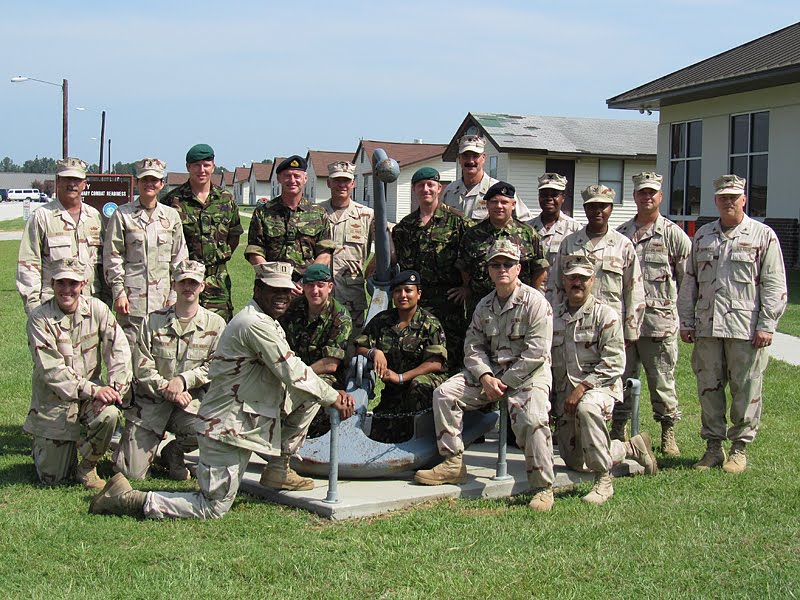
As British and US troops are increasingly working side by side in Afghanistan, a group of Royal Navy personnel recently crossed the Atlantic to compare and contrast pre-deployment training between the UK and America.

The six Royal Navy instructors who visited America last week are based at the Pre-deployment Training and Mounting Centre in Portsmouth. They met their American counterparts at the US Army’s combat training centre at Fort Jackson in South Carolina.

Royal Navy instructors from the Pre-deployment Training and Mounting Centre with their US counterparts at Fort Jackson military base in South Carolina, USA
Picture: Crown Copyright/MOD 2010


When it comes to length of deployment and type of training, the US and the UK have their own ways of doing things and it was hoped that this visit might provide a knowledge-sharing opportunity.

At Portsmouth most of the instructors are Royal Marines with operational experience, whereas the US Navy sailors are taught by the Army at one of eight military bases across the country.

In the UK around 1,000 sailors are trained every year as Individual Augmentees (IAs) who deploy to Afghanistan on a one-in-one-out basis, whereas in the US the total is nearer 40,000.

IAs can be sailors trained in a wide range of skills such as logistics, admin, intelligence or operations, and are able to join units already based in Afghanistan.

Read the full story here

Add to FaceBookAdd to Twitter

Tuesday, May 25, 2010

Afghan Rehearsal Extends to Front Line

A wealth of refinements to the Operational Training and Advisory Group (OPTAG) package has been paying dividends as troops limber up for demanding deployments in Afghanistan, the new Commander of the organisation has said.

In an exclusive interview with MoDOracle.com, Col Rob Thomson revealed that soldiers heading to theatre are being continually prepared – and are honing their skills in Camp Bastion just days before they head out for duty.

And before they arrive, they are receiving up-to-the-minute briefs on developments in Afghanistan, including evolving threats and changes to the mission dynamic, as well as taking part in manoeuvres in ultra-realistic environments.

“Over the last couple of years we have taken a quantum step forward in what we do,” said Thomson. “We have excellent support from the Afghan National Army and Afghan National Police in training so soldiers have never been better prepared.

“Our exercise serials also now take place in some very life-like areas, where we have recreated the look of compounds and forward operating bases the soldiers are going to encounter while they are in theatre,” he added. “In particular, the STANTA training area in Norfolk is very well equipped.”

A veteran infantryman Thomson, who recently replaced Col Richard Westley as Commander OPTAG, certainly has the credentials to lead the organisation. A former CO of the 2nd Battalion, The Rifles, he commanded the NATO Operational Reserve Force in Kosovo in 2008 and last year led troops on one of most ferocious Op Herrick tours yet seen.

For Thomson, however, the learning curve in theatre over the last few years has ultimately led to an OPTAG process that has been instrumental in saving lives. And continuing the training process as troops acclimatise to active theatre conditions is now firmly embedded as part of the initiative.

“When you arrive in Afghanistan, you go through the Camp Bastion Training Centre which really gives you the full fat package before you head out,” he said. “You are given the opportunity to go through your skills and drills one more time and you’re assisted by people who have operational experience.

“This is a key part of the training we have introduced and, in a very short space of time, the centre has grown in terms of the numbers of people working there as well as facilities. Whereas it started out as a package that only lasted between two and five days, we are now running it out to nine where required.”

With the IED a proven killer of British troops, there is significant focus on awareness and detection drills, as well as lanes where troops can rehearse the disciplines. The package builds on drills already honed in training in the UK.


In addition to the growth of the training facilities at Bastion, Thomson pointed out that OPTAG was also continuing to expand in operational acumen and manpower. Those selected for service with the group need a mix of experience in theatre and the ability to impart their knowledge to others.

“We also need to be finely tuned to any changes in theatre because, if there are, we need to be able to replicate them accurately in the training world,” said Thomson. “Out in Afghanistan we are adjusting our tactics, technology and equipment all the time and it is important we maintain our agility.”

Keeping one step ahead of the enemy is certainly vital to success. With the Taliban continuing to deploy reckless tactics that target soldiers and civilians, soldiers must be equipped to fight the insurgents on their own territory.

The OPTAG package provides the means to remain flexible. By keeping incoming brigades aware of what is going on in theatre before they deploy, and finishing off training in a live environment, lives are undoubtedly being saved.

Pictures: Cpl Barry Lloyd RLC

Thursday, June 11, 2009

Afghan war games shatter peace in deepest Norfolk countryside - The Times


For the usually peaceful Norfolk countryside it was a startling sight: a suicide bomber appeared to blow himself up, seriously wounding a passer-by and scaring several sheep.

Thankfully the attacker and his victim were acting. The site of the blast was a mock Afghan village on a military base near Thetford. The exercise is designed to prepare soldiers before deployment to Afghanistan, and commanders believe that it will save lives.

About 60 Afghans who live in Britain as well as more than 100 retired Ghurkas — who are allowed to handle weapons — play the part of villagers, Taleban insurgents and Afghan security forces.

Chickens scuttle across straw-strewn streets framed by high walls, which divide the settlement into small compounds where families live in simple, single-storey stone houses.

Hundred of soldiers from 1st Battalion The Royal Welsh and 1st Battalion The Coldstream Guards became the first to experience the £14 million facility this week.

It also includes a second, more urban Afghan village, four makeshift British bases set in surrounding fields and dirt tracks laden with roadside bombs — the biggest threat facing British troops in southern Afghanistan.

Lieutenant-Colonel Nick Lock, the commanding officer of 1st Battalion The Royal Welsh, will be deployed to Afghanistan with his 550-strong battle group this autumn. He said that the week-long training experience was “absolutely vital”.

“The lessons they have learnt this week are real life-saving lessons,” he told The Times on the main street of the rural village, which cuts through a small market stocked with plastic fruit and fake meat. An explosion shatters the quiet market scene. A cry erupts as stallholders run for cover. A suicide bomber lies dead next to a bicycle.

Second Lieutenant Adam Libbey and his platoon, who were patrolling through the market at the time, jump into action. A wounded civilian is spotted, with part of one leg blown away.

One soldier evacuates him on his back and the area is secured. Lieutenant Libbey, 24, from Cardiff, said that the simulated blast was invaluable training. “You have got to be prepared for all situations,” said the officer, who is due to go to Afghanistan for the first time in October.

Stanford Training Area, where the Afghan village of Sindh Kalay is located, is the second largest military training facility in Britain, stretching across 43 square miles.

Some 80,000 troops use it every year but previously made do with converted European-style houses.

Commanders hope that the new villages will offer soldiers a better idea of what to expect, though they admit that it would have been preferable to have had it sooner given that British troops have been in Afghanistan since 2001. “It has taken a while but we are firmly on it now,” said Colonel Richard Wesley, the head trainer.

The Afghans are mainly former refugees who sought asylum in Britain in the 1980s and 1990s.

Speaking in Pashto and dressed in traditional Afghan robes, the men and a few women pretend to live in the single-room houses, cooking bread in a clay oven and sitting around a log fire as British troops conduct searches, question local leaders and go on patrol.

Fazel Beria, 36, originally from Kabul, co-ordinates the Afghan contractors. “The main aim is for the British soldier to understand the Afghan culture, the way of life and their religion so they won’t make any mistakes, so they will be safe and do their job properly,” he said.
Tackling the 'Taliban' in Norfolk -BBC


By Caroline Wyatt
BBC defence correspondent

Afghan stall-holders beckon to the British soldiers who patrol the bazaar, offering them a salty yoghurt drink and calling out in Pashto as the troops pass by.

There is the distinctive smell of wood-smoke in the air, and in the distance, the call to prayer begins to sound.

Suddenly the calm is shattered by a blast.

A suicide bomber has struck, the force of the explosion sending the market traders diving for cover, and leaving a man lying in apparent agony with one leg blown off.

Immediately, the men of the 1st Battalion the Royal Welsh go into action, some evacuating the casualty to safety, while others warily crouch by hard cover to assess the situation.

Luckily, this is a training exercise, and the only ones who remain nonplussed by this turn of events are a few bewildered sheep who had been grazing peacefully near the new mock village in the Stanford training area, spread over 43 square miles in Norfolk.

A few minutes later the sheep lose interest and move on.

Detailed model

This is the first time the mock "Afghan village" has been put through its paces by forces training for their deployment in Afghanistan.

So far the consensus among the Royal Welsh and the Coldstream Guards using it this week is that the £14m pounds spent on the facilities has been well worth it. Such training now should help to save lives when it is put it into practice, they say.

The "village" of Sindh Kalay has been carefully modelled on the real thing in Helmand province, right down to the wood-smoke and the market stalls, though rarely have I seen such fresh-looking fruit for sale in Helmand.

On closer inspection, though, it turns out to be made of plastic.

The old training village was based on European-style houses and fields, useful for troops deploying to Bosnia or Kosovo but rather less so for the kind of wars British soldiers have been fighting in recent years.

"There has been some real investment in this village, and of my 20 years in the Army, it's the best training I've ever seen - the preparation is superb," says Lieutenant Colonel Toby Gray, commanding officer of the 1st Battalion The Coldstream Guards.

They and the Royal Welsh are due to deploy to Afghanistan later in the year as part of 11 Light Brigade.

Cultural adjustment

Lieutenant Colonel Nick Lock, commanding officer of the 1st Battalion the Royal Welsh, agrees.

"The guys are enjoying the training, and can see real value in being able to practise in a replica situation," he said.

The new facilities also include a more urban Afghan sprawl, mimicking one of the bigger towns, as well as several smaller forward operating bases and dirt tracks where soldiers can train to counter the other main threat from the Taliban in Afghanistan today - roadside bombs or IEDs (improvised explosive devices).