Showing posts with label Royal Navy. Show all posts

Thursday, August 5, 2010

Royal Navy and US Navy compare training for Afghanistan

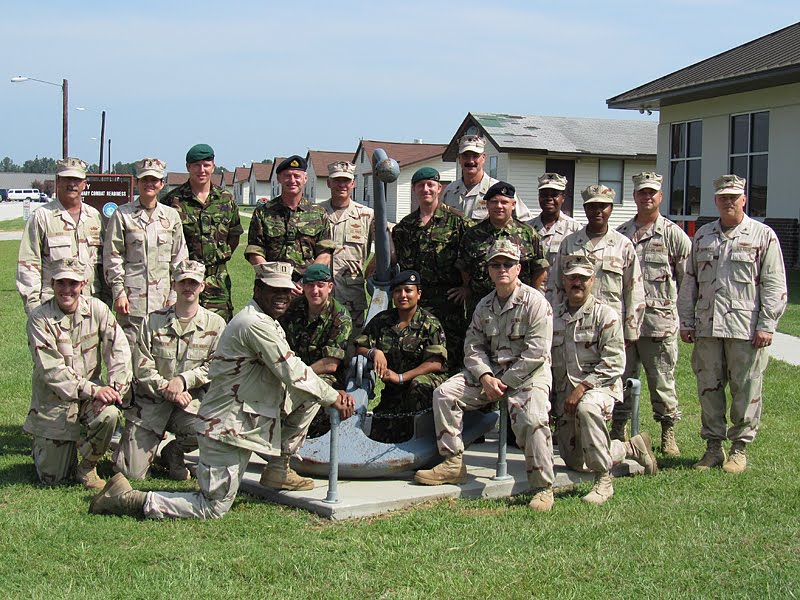
As British and US troops are increasingly working side by side in Afghanistan, a group of Royal Navy personnel recently crossed the Atlantic to compare and contrast pre-deployment training between the UK and America.

The six Royal Navy instructors who visited America last week are based at the Pre-deployment Training and Mounting Centre in Portsmouth. They met their American counterparts at the US Army’s combat training centre at Fort Jackson in South Carolina.

Royal Navy instructors from the Pre-deployment Training and Mounting Centre with their US counterparts at Fort Jackson military base in South Carolina, USA
Picture: Crown Copyright/MOD 2010


When it comes to length of deployment and type of training, the US and the UK have their own ways of doing things and it was hoped that this visit might provide a knowledge-sharing opportunity.

At Portsmouth most of the instructors are Royal Marines with operational experience, whereas the US Navy sailors are taught by the Army at one of eight military bases across the country.

In the UK around 1,000 sailors are trained every year as Individual Augmentees (IAs) who deploy to Afghanistan on a one-in-one-out basis, whereas in the US the total is nearer 40,000.

IAs can be sailors trained in a wide range of skills such as logistics, admin, intelligence or operations, and are able to join units already based in Afghanistan.

Read the full story here

Add to FaceBookAdd to Twitter

Thursday, July 29, 2010

Helping the Afghan Women

By Lieutenant Elaine Boyd Royal Navy

The pace just doesn’t let up out here and it definitely makes the 6-month tour go faster. I am currently living in MOB PRICE alongside the Danish Battlegroup. The accommodation is basic but at least I get a good nights sleep, unlike being onboard with the waves of the Irish Sea knocking me out of my bunk, and constant pipes for ‘big eats’ at the gangway!

The only pipes we hear in MOB PRICE are to inform us that personal communications with the UK are closed, and every time the pipe is made you feel immense sadness knowing the Taskforce has taken casualties. This week we have seen some real highs and some equal lows.


Lt Boyd undertaking her role as part of the Military Stabilisation and Support Team (MSST)

Somewhat unexpectedly the District Governor in Nahr-e Saraj changed over and I attended a “meet and greet” with the new incumbent, and the Battlegroup staff, to discuss the way ahead, and the Governors priorities for the area. Very quickly I found myself inspired (and a little star-struck as he is a hugely important individual in Afghan society) by the Governor, as he spoke passionately about the hopes he has for his district. I work for the District Stabilisation Team which works directly to support the District Governor so I am looking forward to an exciting new chapter under the new Governor’s leadership.

For the full article click here

Add to FaceBookAdd to Twitter

Friday, July 16, 2010

Navy pilots train for Helmand in Californian desert

Royal Navy Sea King helicopter pilots and their crews from the Commando Helicopter Force (CHF) have been training for their deployment to Afghanistan in the Californian desert.


A Sea King conducting load-lifting
[Picture: Crown Copyright/MOD 2010]


The pilots and aircrew from 845 and 846 Naval Air Squadrons have been undergoing environmental qualification training at the Naval Air Facility El Centro, just north of the Mexican border.

The purpose of this training, called Exercise Desert Commando, has been to refresh some of the older pilots and aircrew of the CHF in the techniques required to operate in the harsh conditions of the desert which are similar to those they will face in Helmand.

At the same time, personnel fresh to the front line are getting their first taste of what it is like to work in this environment.

To read more on this story click here


Tweet This


Share on Facebook

Saturday, June 5, 2010

Commander-in-Chief visits Royal Navy personnel in Helmand

Commander-in-Chief Fleet of the Royal Navy, Admiral Sir Trevor Soar, visited Afghanistan this week to see the work that Royal Navy and Royal Marines personnel are doing in Helmand province.

Admiral Soar was accompanied by the newly-appointed Second Sea Lord, Rear Admiral Charles Montgomery, and the Commandant General of the Royal Marines, Major General Buster Howes.

Admiral Sir Trevor Soar addresses Royal Navy personnel and Royal Marines at Camp Bastion

They began their visit in Camp Bastion where they were shown around the busy hospital. Admiral Soar met Royal Navy medical staff and praised and thanked them for all their hard work. Major General Howes took the opportunity to visit injured Royal Marines.

The party were then escorted to the headquarters of the Joint Helicopter Force in Camp Bastion where Admiral Soar addressed the assembled troops. He said:

"On behalf of the Navy, I just want to thank you. Your efforts are appreciated and the wider MOD is clearly aware of the contribution you make."

On leaving Camp Bastion, the three men flew by helicopter to the Task Force Helmand headquarters at Lashkar Gah where they were met by the Commander of 4th Mechanized Brigade, Brigadier Richard Felton, who gave them an update on the situation in Helmand province.

Admiral Sir Trevor Soar, accompanied by Rear Admiral Charles Montgomery and Major General Buster Howes, with members of 40 Commando Royal Marines in Sangin

After this, they boarded a Chinook helicopter and flew to Sangin, where 40 Commando Royal Marines are based during Operation HERRICK 12. They were met by the Commanding Officer of 40 Commando Group, Lieutenant Colonel Paul James.

The guests donned body armour and protective clothing before being guided through Forward Operating Base Jackson to the Fire Support Group tower. From this elevated position the party could view all of the surrounding area and received a detailed ground brief from Lt Col James.

Once this was completed, Major Ed Moorhouse, the Officer Commanding Charlie Company, demonstrated some of the latest kit being used in Afghanistan. This included new sharpshooter rifles and sniper rifles. Admiral Soar was extremely keen to know what the Marines thought of this new kit and the resounding response was that it was excellent.

Admiral Sir Trevor Soar meets Royal Navy medical staff at Camp Bastion's busy hospital

Admiral Soar, Rear Admiral Montgomery and Major General Howes were then introduced to Sangin's District Governor, Mohammad Sherrif, the new Chief of Police, Lieutenant Colonel Ghulie Khan, and the Commander of the resident Afghan National Army Kandak, Lieutenant Colonel Wadood.

A final road move in Mastiff and Jackal vehicles to Forward Operating Base Nolay enabled the group to meet with Officer Commanding Alpha Company, Major Sean Brady, and his team before flying out of Nolay to conclude the visit.

Lt Col Paul James, Commanding Officer, 40 Commando Royal Marines, said:

"It was a privilege having Admiral Soar, Rear Admiral Montgomery and Major General Howes visit us here on the front line in Sangin to see what all the Royal Marines and Royal Navy personnel are up to. They were very supportive and eager to talk to the troops about their experiences."

Pictures: Corporal Gary Kendall RLC & LA(Phot) Si Ethell

Sunday, May 2, 2010

Afghan medal for 857 Naval Air Squadron


77 Royal Navy Sea King crew members from 857 Naval Air Squadron have been presented with their Afghanistan Operational Service Medals by The Prince of Wales.

Naval Officers and Ratings from the Squadron marched from Wellington Barracks past Buckingham Palace and up the Mall to receive the Operational Service Medal at a Royal medal presentation ceremony at Clarence House London. The Squadron was deployed to Afghanistan to conduct Air Operations between October 2009 and March 2010.

The “eye-in-the-sky” capability of the Mark 7 Sea King provides vital information to forces tackling the insurgency in the region and this capability is key to achieving security and stability for those living in the area.

Lt Cdr Steve Lynch, Commanding Officer of 857 NAS said; “This is a very proud and special day for the Squadron personnel and their supportive families, I am honoured to bring the Squadron to London to highlight the Navy contribution to security operations in Afghanistan. This is an event we have all looked forward to and while we may enjoy the ceremony today, we remember that our friends and colleagues are still on call for flying operations every day in Afghanistan until we return to take their place.”

Thursday, December 10, 2009

Royal Navy Sea Kings - flying over Afghanistan for two years


For two years the green Sea King Mk4s of the Commando Helicopter Force (CHF) have been heavily involved in flying operations in Afghanistan as part of the Joint Helicopter Force.

The 'Jungly' squadrons have considerable operational experience out here and that as well as the aircraft's increased performance and capability, has earned them an enviable reputation for reliability in the face of adversity.

The nickname 'Jungly' evolved during the Borneo Campaign of 1963-66, as it was within the Indonesian jungle that squadrons of the Royal Navy proved their versatility.

Sunday, November 29, 2009

PICTURE of the day: Sea King sortie in Helmand


A Royal Navy Sea King on a routine sortie packed with mail for troops at one of the forward operating bases.

Front door gunner scanning the ground below for threats.

Thursday, October 29, 2009

Navy divers swap the depths of the sea for frontline Afghanistan


Four brave navy divers have swapped the ocean depths for the Afghan desert as they try to save soldiers' lives on the frontline.

The bomb disposal experts – all based at Horsea Island in Portsmouth – will deal with hidden explosives meant to injure or kill British troops.

Petty Officer Jai Gardner, Leading Seaman Ian Higgins as well as Able Seamen Chris Collins and Les Cockerton are part of the first navy team to ever serve in bomb disposal in Afghanistan.

They have been sent out to work with army teams to deal with a rise in the number of bombs planted by the Taliban.

Between April and October this year, 24 soldiers were killed and 137 wounded in the Sangin district of Helmand alone.

Explosives were responsible for more than 90 per cent of those casualties.

Meanwhile more than 400 bombs have been found – almost three times more than in 2008.

Peter Greenwood, in charge of Portsmouth's Fleet Diving Squadron, said: 'This is a major new role for the Clearance Diving Branch.

'Although we have operated from Basra in Iraq for the past two years, Helmand is a completely different environment. It's more intensive and there is a higher level of threat.

'They have to be as good on the ground as soldiers – competent with personal weapons and how to operate as war fighters on a patrol.

'And they also have to keep cool heads to deal with ordnance that the squad encounters.'

The navy divers will be based in so-called 'forward bases' on the frontline.

The deadly threats they have to tackle include bombs, mortars and grenades, used by both coalition and Taliban forces. But they will also be ready to deal with the notorious Improvised Explosive Devices – IEDs – if the army is not available.

By finding and removing the IEDs, the team hopes to reduce the severe injuries that blight servicemen's lives.

While their first role will always be to make bombs safe, the navy team will also try and find out more about the weapons the Taliban use.

PO Gardner said: 'If we come across something really new we will call for the army experts and stand back to allow them to maximise the forensics. There is no value in us just going in and trying to blow everything up.'

A wife of one of the navy divers working in Afghanistan has called her husband 'a real hero'.

Sue Cockerton said Les had a wicked sense of humour and was keeping spirits up during a tough mission.

The 40-year-old mother-of-three said she was speaking with AB Cockerton, 30, as often as possible.

She said: 'I have nothing but praise for Les and all of the team, they are a group of heroes to me.

'They are doing an incredibly brave job and my only hope is that they all come back safely.'

The Cockertons married in April in Portsmouth Naval Base, a month earlier than planned because of the deployment.

After their honeymoon in Los Angeles he went to train for the bomb disposal work, before leaving Portsmouth at the beginning of this month.

Mrs Cockerton, from Locks Heath, said: 'Since he has been in Helmand we have spoken on the phone and he has asked me to keep positive.

'We have special messages we pass to each other, and I do my best to let him know as much as possible about normal, everyday life.

'We have an 18-month-old son and he is always really keen to find out how he's doing.

'It's very hard not to talk about your fears, but you know the best way to help someone you love is to be strong for them.'
Thursday, September 24, 2009

Royal Navy Sea Kings 'bag' intelligence over Helmand


The Royal Navy's unique airborne surveillance and control helicopters, known as 'Baggers', have recently deployed to Helmand for the first time, where they are detecting, following and intercepting insurgent activity.

The Mk7 helicopters are known as Baggers thanks to the large grey 'bag' which contains the aircraft's state-of-the-art radar.

Primarily used in the maritime surveillance role, the helicopter's powerful onboard sensors also enable it to provide valuable battlefield reconnaissance and targeting information at particular times in land operations, and in May this year Sea King Mk7s from 854 Naval Air Squadron (NAS) were deployed to Afghanistan.

After a month acclimatising to conditions in Camp Bastion and exercising with allied forces in theatre, the Baggers and support personnel from 854 NAS were sent aloft on missions from the middle of June onwards.

Commander Matt Avison, Commander Sea King Force, said:

"The job is to throw a light into areas which are regarded as a black hole - vast areas outside the 'Green Zone' in Helmand - and give the commanders on the ground an idea of what is going on.

"Almost every sortie has produced useful information and there have been many - and significant - results."

Friday, June 26, 2009

Harrier heroes return home


RAF and Royal Navy top guns are on their way home after five years of supporting heroic soldiers in the battle against Taleban extremists.

1 (F) Squadron’s Harrier jump jets, from RAF Cottesmore in Rutland, have been fighting for the people of Afghanistan, and supporting brave British and NATO troops by attacking insurgents in the blistering deserts and barren mountains of Afghanistan. They depart Afghanistan on 26 June.

Since 2000, the RAF and the Navy’s Fleet Air Arm have flown Harriers together under the Joint Force Harrier formation. Navy and Royal Marines pilots have been fighting alongside their RAF comrades since the Harrier first arrived in Afghanistan five years ago.

Every Harrier pilot from every Harrier squadron has taken part in the fight. Over the past five years, more that 22,000 hours have been flown on more than 8,500 sorties, mainly over Helmand province.

1 (F) Sqn – the RAF’s oldest squadron, formed in 1912 – has been in Afghanistan four times before, alternating with the RAF’s 4 Squadron and the Fleet Air Arm’s Naval Strike Wing. The last Harriers in Afghanistan have been replaced by Tornado GR4 strike jets from 12 Sqn, based at RAF Lossiemouth in Morayshire.

Wing Commander Dave Haines, 1 Sqn’s commanding officer, says that Taliban fighters would “flee in terror” when they heard the deafening roar of Harrier jets giving “shows of force” when troops were under fire. “We deliver an awesome effect,” said the 39-year-old.

“Our guys on the ground can guide us to the enemy using TV data links. After making sure that we’re not going to harm any civilians, we can fire our missiles from such a distance that the insurgents don’t even know we’re there; sometimes the last thing they hear is the crack of a missile’s sonic boom before it hits.

“We’re here at the invitation of the Afghan government,” he added. “We do absolutely everything we can to make sure that civilians are safe; they’re the people we’re fighting for.”

Royal Marines hero Captain Michael Carty, 27, has been fighting Taliban terrorists since 2002 – first as a troop commander with 45 Commando, leading Marines into battle, and now as an elite Harrier pilot supporting Our Boys from above. “I used to lead 35 lads on the ground,” he said, after a 3-hour mission to hit the Taliban’s fighters. “That gives me a great appreciation of what it’s like for those in the field.”

Capt Carty now helps to keep insurgents at bay while RAF and Royal Navy helicopters fly medics into battle to extract wounded soldiers from the front line. “It makes me really proud,” he said. “Even helping our guys in a small way is fantastic.

“Whether we’re keeping an eye out for insurgents while the troops are clearing a compound, or warning patrols about suspicious activity, I get huge satisfaction from knowing I’ve done my bit.”

HARRIER GR9 FACT FILE

• Engines: RR Pegasus 105 or 107 turbofan
• Thrust: 21,750lbs
• Max speed: 574kts
• Length: 14.36m
• Max altitude: 43,000ft
• Span: 9.25m
• Aircrew: 1